He Cannon on a Battleship Can Fire a Shell a Maximum Distance of 26.0 Km.
The cannon on a battleship can fire a crush a maximum altitude of 32.0 km. (a) Calculate the initial velocity of the shell. (b) What maximum height does it accomplish? (At its highest, the shell is above 60% of the atmosphere—merely air resistance is non really negligible equally assumed to make this problem easier.) (c) The bounding main is non flat, because the Earth is curved. Assume that the radius of the Earth is 6.37×10³ km . How many meters lower will its surface exist 32.0 km from the send along a horizontal line parallel to the surface at the ship? Does your respond imply that fault introduced past the assumption of a apartment World in projectile movement is pregnant here?
Solution:
Part A
We are given the range of the projectile move. The range is 32.0 km. We as well know that for the projectile to reach its maximum distance, information technology should exist fired at 45°. Then from the formula of range,
\displaystyle \text{R}=\frac{\text{5}_0^2\:\sin 2\theta _0}{\text{g}} we tin can say that \sin 2\theta _0=\sin \left(2\times 45^{\circ} \correct)=\sin 90^{\circ} =1. So, nosotros accept
\displaystyle \text{R}=\frac{\text{5}_0^2}{\text{g}} We can solve for v0 in terms of the other variables. That is
\displaystyle \text{v}_0=\sqrt{\text{gR}} Substituting the given values, we accept
\brainstorm{align*} \displaystyle \text{v}_0 & =\sqrt{\left(9.81\:\text{m/s}^2\right)\left(32\times 10^3\:\text{yard}\right)} \\ \displaystyle \text{5}_0 & =560.29\:\text{m/south} \ \qquad \ \color{DarkOrange} \left( \text{Answer} \right)\\ \end{align*} Part B
Nosotros are solving for the maximum top here, which happened at the mid-flight of the projectile. The vertical velocity at this point is nada. Considering all this, the formula for the maximum height is derived to be
\displaystyle \text{h}_{\text{max}}=\frac{\text{v}_{0_y}^2}{2\text{g}} The initial vertical velocity, v0y , is calculated equally
\brainstorm{marshal*} \text{v}_{\text{0y}} & =\text{v}_0\sin \theta _0 \\ & =\left(560.29\:\text{one thousand/s}\right)\sin 45^{\circ} \\ & =396.xviii\:\text{m/s} \terminate{marshal*} Therefore, the maximum top is
\begin{align*} \text{h}_{\text{max}} & =\frac{\left(396.18\:\text{k/s}\right)^2}{2\left(nine.81\:\text{grand/southward}^2\right)} \\ \text{h}_{\text{max}} & =8000\:\text{k} \ \qquad \ \color{DarkOrange} \left( \text{Answer} \right) \\ \finish{marshal*} Function C
Consider the post-obit figure
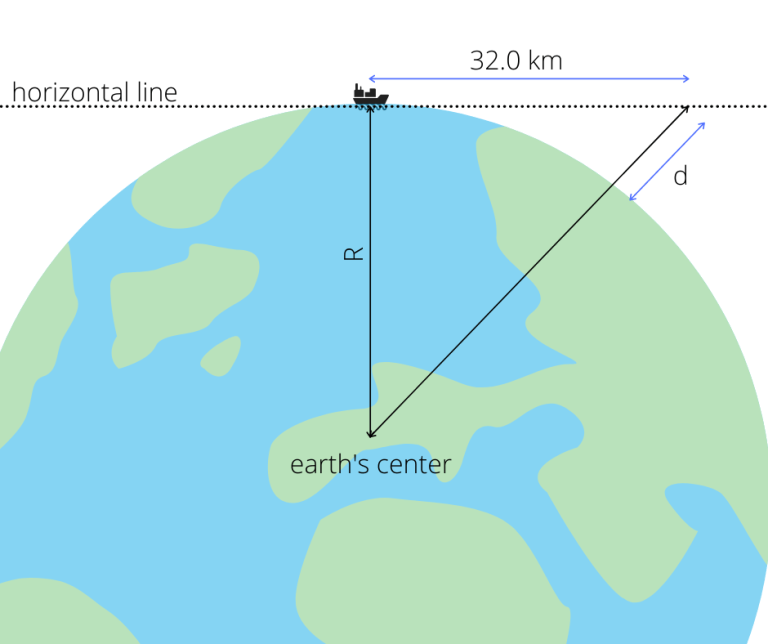
A right triangle is formed with the legs, the horizontal altitude and the radius of the world, and the hypotenuse is the sum of the radius of the earth and the altitude d , which is the unknown in this problem. Using Pythagorean Theorem, and converting all units to meters, we accept
\begin{align*} \text{R}^two+\left(32.0\times 10^three\:\text{yard}\right)^2 & =\left(\text{R}+\text{d}\right)^2 \\ \left(6.37\times 10^half-dozen\:\text{grand}\right)^ii+\left(32.0\times 10^3\:\text{one thousand}\right)^2 & =\left(6.37\times 10^6+\text{d}\correct)^2 \\ \text{d} & =\sqrt{\left(6.37\times \:ten^6\:\right)^ii+\left(32.0\times 10^3\:\right)^ii}-6.37\times \:ten^six \\ \text{d} & =80.37\:\text{m} \ \qquad \ \color{DarkOrange} \left( \text{Answer} \right) \\ \end{align*} This error is not significant because information technology is but about 1% of the maximum elevation computed in Function B.
Source: https://www.engineering-math.org/2020/06/18/college-physics-3-33-a-cannon-fired-from-a-battleship/
0 Response to "He Cannon on a Battleship Can Fire a Shell a Maximum Distance of 26.0 Km."
Post a Comment